Perry Smith and Dick Hickock’s partnership
In Cold BloodPerry Smith and Dick Hickock’s partnership joined two men whose hopes for a shared future were never quite the same. Dick treated Perry’s capacity for violence as an asset that could advance his own plans; Perry, in turn, found in Dick a lively, practical companion who did not dismiss his extravagant travel dreams. Their alliance rested on genuine affection and shared purpose, but also on concealment and calculation. When their plans began to unravel, they remained bound together less by trust than by the danger of standing alone.
Origins and Unequal Expectations
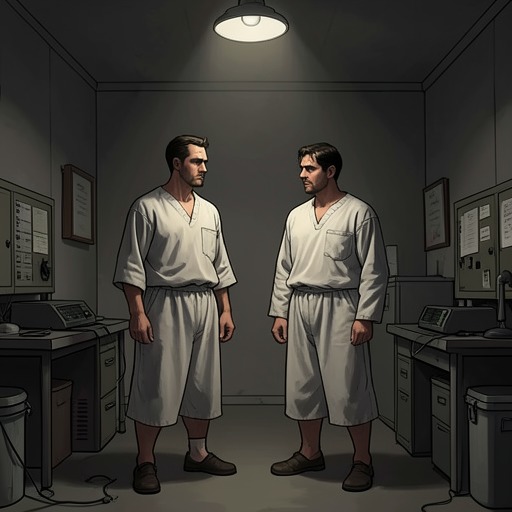
Perry and Dick had met while imprisoned at Kansas State Penitentiary, where their acquaintance grew during Perry’s final months there. Dick had been released on parole in mid-August, with the condition that he live with his parents near Olathe, Kansas. He was twenty-eight, had been married and divorced twice, and had three sons. His family’s discomfort with Perry was not, as Perry first suspected, a personal judgment: Dick explained that they objected to his seeing anyone from prison. A blue tattoo beneath Dick’s left eye marked him as someone recognizable to former inmates, a visible sign of the prison world that followed him home.
Perry responded to Dick’s family worries with sympathy, speaking warmly of Dick’s mother. Their exchange shows a softer register than the criminal planning that would define their partnership: Perry could be attentive to Dick’s attachments, and Dick accepted that kindness. In prison, Dick had also composed a set of obscene verses to please Perry. Perry found them funny enough to have the manuscript bound in the prison shop, with its title stamped in gold. The gesture turned crude humor into a private keepsake, evidence of a playful intimacy that coexisted with their harder purposes.
Their temperaments, however, pointed toward different futures. Perry was an incessant planner of voyages, collecting maps of states, Canadian provinces, and South American countries. He carried a guitar and boxes of books, maps, songs, poems, and old letters; even his possessions testified to a life imagined in motion. Dick preferred the prospect of a settled life, with a business, a house, a horse, and a new car. He listened to Perry’s talk of buried treasure and distant coasts, but those were not ambitions he shared for their own sake.
The Invitation and the Choice
After parole, Perry spent four months drifting in a cheap, well-used Ford, traveling between places that included Reno, Las Vegas, and Bellingham, Washington. While he was working temporarily as a truck driver in Buhl, Idaho, Dick’s letter reached him with an invitation to join a promising score. Until then, Perry had not expected to see Dick again. He considered the invitation partly in relation to Willie-Jay, the prison chaplain’s clerk whose judgment and admiration had mattered deeply to him.
Perry had taken Willie-Jay’s criticism of his anger and resentment seriously, even as he disputed its fairness. He felt that Willie-Jay had recognized his artistic potential and unusual qualities. Dick offered something different: fun, realism, and a willingness to listen without attacking Perry’s far-flung aspirations. Perry regarded Dick as shrewd and unsentimental, someone who could cut through a situation, even if he might be shallow or boastful. Their friendship thus answered needs that did not neatly overlap. Perry wanted recognition and companionship; Dick wanted a partner for a plan he believed could be made profitable.
Perry drove to Las Vegas, sold his worn-out car, packed his books and maps, and took a Greyhound bus toward Kansas. He hoped that he might reunite with Willie-Jay before committing himself to Dick’s proposal. But Perry arrived in Kansas City on the evening of November 12, five hours after Willie-Jay had departed from the same terminal. A chaplain confirmed that Willie-Jay had gone east, without disclosing his destination. Perry was left angry and disappointed, and the possibility of joining Dick became, in effect, his only available choice. In retrospect, Perry believed that even an hour with Willie-Jay might have kept him from the course on which he was now embarking.
A Working Alliance
In Olathe, Dick and Perry met in a café while Perry studied a worn map of Mexico. The destination suited Perry’s accumulated fantasies: he had marked places associated with beaches, fishing, casinos, parrots, and hidden treasure. Dick had proposed the score, but the southward journey that Perry imagined gave the proposal an appeal beyond immediate gain. Their partnership could be pictured as both a job and an escape: a practical undertaking for Dick, and a possible passage into Perry’s dreamed-of life abroad.
Dick’s conduct in prison had concealed how narrowly he viewed that future. He had cultivated Perry by flattering him and appearing to share interests in treasure hunting, diving, and seaports that did not genuinely attract him. What he wanted, as the narrative makes clear, was an ordinary, comfortable life. He believed Perry might help him get it. His assessment of Perry had changed after Perry recounted having killed a man in Las Vegas; Dick came to regard him as exceptionally capable of killing without remorse. Dick thought such a capacity could be used under his direction. The partnership therefore contained a fundamental deception: Perry took Dick’s apparent interest in his dreams as a bond, while Dick treated that interest as a way to secure Perry’s participation.
The alliance also demanded practical labor. At the garage where Dick worked, he and Perry serviced Dick’s aged Chevrolet, changing its oil, adjusting the clutch, recharging the battery, replacing a throw-out bearing, and fitting new rear tires. Dick was a capable mechanic, and the car was expected to endure punishing use. Their preparation made the partnership tangible: the shared plan depended not only on Dick’s persuasion and Perry’s involvement, but on the two men working side by side over a vehicle meant to carry them onward.
Dependence, Suspicion, and Conflict
The difference between the men’s motives did not remain hidden forever. Dick worried that Perry might be losing his nerve and wondered whether he had misjudged him. His conviction that Perry was a rare, usable force had helped bring them together; if Perry proved ordinary or unwilling, Dick feared the plan would collapse. At the same time, he needed Perry not to recognize that Dick’s interest in his dreams had been strategic. Their alliance was therefore vulnerable at its foundation: Dick wanted to direct Perry, while Perry wanted a companion who would share a life he had imagined long before Dick’s proposal.
After the crime, their conversation about Floyd Wells brought that tension into the open. Perry pointed out that Wells could connect them to the case, provoking Dick’s fury. Perry understood that his remark had struck at Dick’s confidence, and he considered whether he could defend himself if the argument became physical. He was shorter, and his damaged legs made running unreliable, but he was heavier and stronger in the arms. The calculation was not merely about who might win a fight. Perry recognized that a real break between them was unsafe, while the plans they had made together still held some attraction for him.
Dick had already expressed the principle that kept them together: if they were caught, they should be caught together and support each other when questioned. The agreement offered a form of mutual protection, but it also acknowledged their exposure and mistrust. Perry could resent Dick, and Dick could turn on Perry in anger, yet neither could easily leave without surrendering both practical support and the remaining possibility of their shared escape plan.
The Partnership’s Meaning
The story places the men’s private alliance against the fear spreading through the communities around the crime. In Holcomb, people left their windows lit through the night, bought locks, and wondered whether the killer lived nearby. Some residents moved away because their families could no longer sleep. The contrast is severe: while neighbors struggled with the collapse of trust, Perry and Dick sat together elsewhere, trying to judge whether the past had left a trail back to them. Their partnership was not simply a personal bond; it was the concealed human connection behind a rupture in communal confidence.
Perry and Dick’s relationship persists through this contradiction. It includes jokes, a favor preserved in a gold-stamped book, sympathy for family troubles, shared work, and dreams of traveling south. It also includes Dick’s manipulation of Perry’s aspirations, Perry’s recognition of that possibility, and their decision that mutual dependence was safer than separation. They were companions, but not partners in an equal or fully shared vision. The more their plans depended on each other, the harder it became to tell loyalty from necessity.